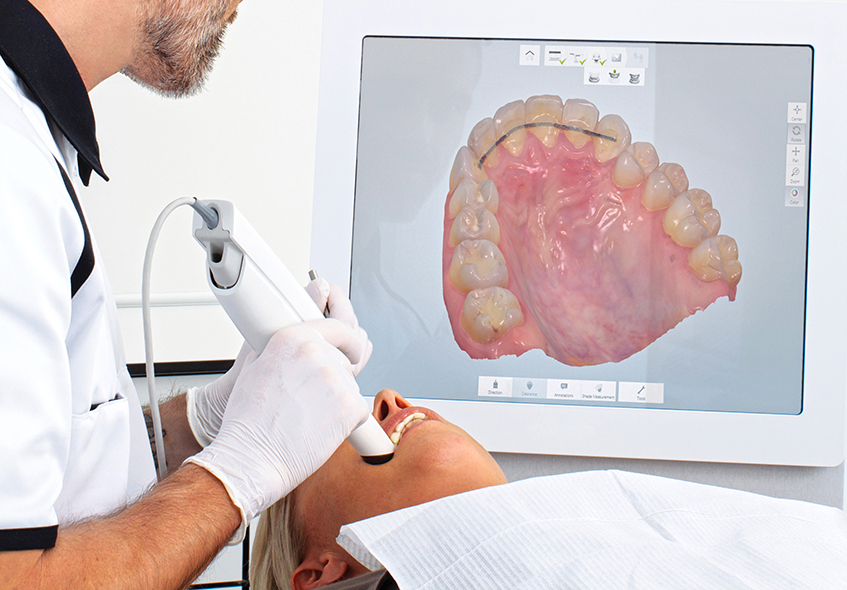
Digital Dental Impressions
Experience Modern Digital Dentistry with an Intraoral Scanner
Dental impressions have traditionally been taken using impression trays and impression materials. Today, intraoral scanning offers a modern digital alternative for many dental procedures.
At Dr. Bharat Katarmal Dental & Implant Clinic, Jamnagar, we use the Aoralscan 3 Shining 3D intraoral scanner to capture digital information about your teeth and oral structures.
Instead of placing a tray filled with impression material in your mouth, a small handheld scanner is moved over the teeth to create a three-dimensional digital model of the scanned area.
This digital information can then be used as part of modern CAD/CAM dental workflows for diagnosis, treatment planning and fabrication of selected dental restorations and appliances.
What Is an Intraoral Scanner?
An intraoral scanner (IOS) is a digital dental device that optically captures the surfaces of teeth and surrounding oral structures.
During scanning, the dentist moves the scanner over the teeth while the system captures a series of images and processes them using specialized software to create a 3D digital representation of the scanned area.
In simple words:
An intraoral scanner replaces many conventional dental impressions with a digital scan of your mouth.
Digital impressions can then be transferred electronically to dental laboratories or digital dental software for further planning and fabrication.
Your existing page describes digital impressions as computer-generated replicas created using an optical scanning device.
Aoralscan 3 Intraoral Scanner at Our Jamnagar Dental Clinic
We have invested in Aoralscan 3 Shining 3D intraoral scanning technology as part of our commitment to modern digital dentistry in Jamnagar.
The scanner allows us to capture digital dental impressions without routinely requiring conventional impression trays and impression materials.
Depending on your treatment, these digital records can be useful for:
- Crowns
- Bridges
- Dental implants and implant prostheses
- Veneers
- Smile design
- Orthodontic treatment
- Clear aligner planning
- Selected restorative and prosthodontic procedures
- Digital treatment planning
The appropriate impression technique is always selected according to the treatment and clinical situation.
How Does an Intraoral Scanner Work?
The process is relatively simple.
Step 1: Scanning the teeth
The dentist gently moves the scanner inside your mouth over the teeth and relevant oral structures.
Step 2: Capturing digital images
The scanner continuously captures optical information from the surfaces being scanned.
Step 3: Creating a 3D digital model
The scanning software combines the captured information to generate a three-dimensional digital model.
Step 4: Checking the scan
The dentist can immediately inspect the digital impression on the computer screen and rescan areas if additional information is required.
Step 5: Digital transfer
The digital file can be used in appropriate CAD/CAM workflows for treatment planning and fabrication of dental restorations or appliances.
This immediate digital workflow is one of the important differences between an intraoral scan and a conventional impression.
Digital Impression vs Conventional Dental Impression
Traditional dental impressions involve placing an impression tray containing a material in the patient's mouth and allowing the material to set.
Some patients find this uncomfortable, particularly when the tray or impression material stimulates the gag reflex.
Tool Used
Conventional Impression: Impression tray is used
Digital Impression: Handheld scanner is used
Material Requirements
Conventional Impression: Impression material is placed in the mouth
Digital Impression: No conventional impression material
Capture Time
Conventional Impression: Material needs time to set
Digital Impression: Digital scan is created on screen
Data Transfer
Conventional Impression: Physical impression is transported
Digital Impression: Digital file can be transferred electronically
Patient Comfort
Conventional Impression: Some patients experience gagging
Digital Impression: Often more comfortable for patients
Model Creation
Conventional Impression: Physical model may be required
Digital Impression: Digital 3D model can be used
Importantly, digital scanning does not make conventional impressions obsolete in every situation. Certain clinical circumstances may still favour conventional impression techniques.
Is an Intraoral Scan More Comfortable?
For many patients, yes.
One of the major advantages of digital scanning is that it eliminates the need for conventional impression material and trays in situations where an intraoral scan is appropriate.
Research consistently reports a patient preference for digital impressions, particularly because of improved comfort and reduced unpleasantness compared with conventional impression procedures. A 2025 systematic review of implant-supported prosthodontic impressions found that the studies evaluating patient perception consistently favoured digital impressions.
Another systematic review found that intraoral scanning was associated with greater patient preference and reduced impression-taking time compared with conventional methods.
This can be particularly helpful for patients who:
- Have a strong gag reflex
- Dislike impression material
- Feel uncomfortable with impression trays
- Prefer digital technology
Are Digital Dental Impressions Accurate?
Yes, intraoral scanners can provide clinically useful and accurate digital impressions—but accuracy is not identical in every situation.
Benefits of Intraoral Scanning
1. More Comfortable Impression Procedure
There is no need for conventional impression material and tray when digital scanning is suitable.
This can make the procedure more comfortable for many patients.
2. Reduced Gagging
Because conventional impression material is avoided, patients who have difficulty tolerating impression trays may find digital scanning easier.
3. Immediate Digital Visualization
The scanned teeth can be viewed on a computer screen immediately.
This allows the dentist to inspect the scan and identify areas that may require additional scanning.
4. Faster Digital Workflow
Digital impressions eliminate several physical steps involved in conventional impression workflows.
Studies have found reduced impression-taking and adjustment times in several clinical applications.
5. Easy Digital Transfer
Digital impression files can be electronically transferred to an appropriately equipped dental laboratory or digital workflow.
This can simplify communication between the dental clinic and laboratory.
6. Useful for CAD/CAM Dentistry
Digital scans can form part of CAD/CAM workflows used for designing and manufacturing selected dental restorations and appliances.
7. Better Patient Communication
A digital 3D model allows the dentist to show patients their teeth on the screen.
This can help patients understand certain dental conditions and proposed treatment options.
8. Digital Record
A digital scan can be stored electronically and, where clinically appropriate, compared with subsequent scans.
This can be useful for monitoring changes over time.
Intraoral Scanner for Crowns and Bridges
The digital scan records the prepared tooth and surrounding structures and can be incorporated into a digital laboratory workflow.
Research suggests that digital and conventional impressions can produce clinically acceptable fixed restorations in many situations, although performance depends on the clinical case and scanning conditions.
Intraoral Scanner for Dental Implants
Intraoral scanning is increasingly used in digital implant dentistry.
Digital implant impressions can capture the position of implants using appropriate scan bodies and can be incorporated into digital implant prosthetic workflows.
However, implant scanning—particularly full-arch implant cases—is technically more demanding. Accuracy can be influenced by factors such as implant position, scan-body design, scanner, scanning strategy and operator experience.
Intraoral Scanner for Smile Design
Digital scanning can be incorporated into digital smile design and restorative treatment planning of Full Mouth Rehabilitation.
A digital model of the patient's teeth can be combined with other digital records, photographs and planning software where appropriate.
This allows the dentist and patient to discuss proposed restorative changes before treatment.
Your original page already identifies smile design as one of the applications of your intraoral scanner.
Intraoral Scanner for Orthodontics and Clear Aligners
Digital dental impressions are widely used in modern orthodontic workflows.
Instead of conventional impression material, an intraoral scanner can create a digital model of the teeth that may be used for orthodontic assessment, treatment planning and selected clear-aligner Invisalign® workflows.
Digital scans can also make it easier to visualize tooth position and communicate treatment plans with patients.
Is Digital Scanning Better Than Traditional Impressions?
There is no single answer for every patient.
Digital scanning has important advantages:
✔ More comfortable for many patients✔ No conventional impression material
✔ No impression tray when scanning is appropriate
✔ Immediate visualization
✔ Easy digital storage and transfer
✔ Efficient digital workflow
✔ Useful for CAD/CAM dentistry
✔ Excellent patient communication
But conventional impressions still have a role.
For certain clinical situations where direct light can not reach—particularly in undercut area or some extensive or complete-arch cases—conventional impressions may still provide advantages, and the evidence regarding full-arch accuracy remains mixed.
Our goal is not to use technology simply because it is new. Our goal is to use the appropriate technology when it can benefit your treatment.
Why We Use Intraoral Scanning at Our Jamnagar Dental Clinic
At Dr. Bharat Katarmal Dental & Implant Clinic, Jamnagar, we believe that modern dental technology should serve a clinical purpose.
Our Aoralscan 3 Shining 3D intraoral scanner allows us to incorporate digital impressions into appropriate restorative, implant, cosmetic and orthodontic workflows.
The technology can make impression procedures more comfortable, improve digital communication and simplify selected laboratory workflows.
Most importantly, the scanner is used as one component of comprehensive clinical diagnosis and treatment planning—not as a replacement for the dentist's clinical judgment.
Frequently Asked Questions About Intraoral Scanners
What is an intraoral scanner?
An intraoral scanner is a digital dental device that optically captures the surfaces of teeth and oral structures and converts them into a three-dimensional digital model.
Is an intraoral scan painful?
No. Intraoral scanning is a non-invasive procedure and generally does not cause pain. Some patients may experience minor discomfort depending on the area being scanned and the length of the procedure.
Does an intraoral scanner replace dental impressions?
For many dental procedures, yes. However, conventional impressions are still appropriate or preferred in certain clinical situations.
Is digital scanning better than conventional impressions?
Digital scanning offers important advantages in comfort, workflow and patient preference. However, it is not universally more accurate in every clinical situation. The appropriate technique depends on the treatment and individual case.
Can an intraoral scanner be used for dental crowns?
Yes. Digital impressions are widely used in appropriate crown and fixed prosthodontic workflows.
Can an intraoral scanner be used for dental implants?
Yes. Intraoral scanners can be used for digital implant impressions in appropriate cases. However, full-arch implant scanning is more technically demanding, and accuracy depends on several factors.
Can an intraoral scanner be used for Invisalign or clear aligners?
Digital scans can be used in orthodontic and clear-aligner workflows when the treatment provider and aligner system support digital impressions.
Will I need a conventional impression?
Not necessarily. If your treatment is suitable for digital scanning, an intraoral scan may be used instead. Your dentist will select the impression technique based on your individual treatment requirements.
Which intraoral scanner do you use?
At Dr. Bharat Katarmal Dental & Implant Clinic, Jamnagar, we use the Aoralscan 3 Shining 3D intraoral scanner for appropriate digital dentistry applications.
Authoritative References
The journal of American Dental Association : Intraoral scanners :
https://jada.ada.org/article/S0002-8177(21)00312-3/pdf
Experience Digital Dentistry in Jamnagar
If you need a dental crown, bridge, dental implant, veneer, smile makeover, orthodontic treatment or another procedure requiring a dental impression, ask whether a digital intraoral scan is appropriate for your treatment.
At Dr. Bharat Katarmal Dental & Implant Clinic in Jamnagar, our Aoralscan 3 intraoral scanner allows us to incorporate modern digital impression technology into suitable dental treatments.
Less mess. More comfort. Digital precision. Modern dentistry.
Dr. Bharat Katarmal Dental & Implant Clinic, Jamnagar