Tooth-Colored Dental Filling
Natural-Looking Composite Fillings for Decayed or Damaged Teeth in Jamnagar
Do you have a cavity in your tooth but don't want a visible silver-colored filling?
Composite filling, also known as a tooth-colored filling, white filling or cosmetic dental filling, can restore a decayed or damaged tooth while closely matching the natural color of your teeth.
At Dr. Bharat Katarmal Dental & Implant Clinic, Jamnagar, composite resin fillings are used to restore suitable teeth affected by dental cavities, small fractures, worn tooth surfaces and certain cosmetic defects.

Our aim is not simply to "fill a hole" in a tooth. The goal is to remove diseased tooth structure conservatively, restore the shape and function of the tooth, and achieve a natural-looking result whenever clinically appropriate.
Looking for composite filling in Jamnagar? A dental examination can determine whether a composite filling is appropriate for your tooth or whether another treatment, such as an inlay, onlay, crown or root canal treatment, would provide a more predictable result.
What Is a Composite Filling?
A composite filling is a tooth-colored dental restoration made from resin-based composite material containing a resin matrix and inorganic filler particles, such as glass.
The material can be selected and shaped to closely match the surrounding tooth. Composite resin is commonly used as a direct restorative material, meaning it can be placed directly into a prepared cavity and hardened inside the mouth.
Unlike traditional silver-colored amalgam fillings, composite fillings are designed to blend with the natural appearance of the tooth.
In India, the Government's e-DantSeva oral-health resource describes composite fillings as tooth-colored fillings used to restore tooth structure destroyed by dental caries.
Why Does a Tooth Need a Filling?
Dental cavities develop when acids produced by oral bacteria gradually remove minerals from the tooth. If this process continues, the tooth structure can break down and form a cavity.
Very early tooth decay, before a cavity has formed, may sometimes be stopped or reversed with preventive measures such as fluoride. However, once a permanent cavity has formed, the damaged tooth structure generally needs restorative treatment.
A composite filling may be considered when the amount and location of tooth damage are suitable for a direct restoration.

Common situations where composite filling may be used include:
- Dental cavities caused by tooth decay
- Small to moderate areas of tooth destruction
- Cavities between teeth
- Cavities on front teeth
- Certain cavities on back teeth
- Small chipped or fractured areas
- Replacement or repair of selected defective restorations
- Certain cosmetic reshaping procedures -Smile Makeover
- Repair of minor worn or damaged tooth surfaces
However, not every cavity should be treated with a composite filling. The size, depth and location of the cavity and the remaining tooth structure must be evaluated before selecting the restoration.
Why Choose a Tooth-Colored Composite Filling?
1. Natural Appearance
One of the biggest advantages of composite resin is its tooth-colored appearance.
The shade can be selected to closely resemble the surrounding tooth, making the restoration much less noticeable than a dark or silver-colored filling.
This is particularly important when restoring visible front teeth.
2. Conservative Tooth Restoration
When clinically appropriate, adhesive composite restorations can allow the dentist to restore a cavity while preserving sound tooth structure.
However, the amount of tooth preparation required depends on the individual cavity and restoration design. A composite filling does not mean that every cavity can be treated without removing any healthy tooth structure.
3. Restores Tooth Shape and Function
A filling is not merely a cosmetic patch.
A properly designed composite restoration can help restore:
- Tooth anatomy
- Contact with adjacent teeth
- Biting function
- Chewing function
- Tooth appearance
The final restoration should be properly shaped, finished and polished.
4. Useful for Front Teeth
Composite resin is particularly useful where appearance is important because its shade can be matched to the natural tooth.
For suitable chipped, fractured or decayed front teeth, composite bonding can sometimes provide an aesthetically pleasing alternative to more extensive restorations.
How Is a Composite Filling Done?
The procedure generally involves several carefully controlled steps.

Step 1 – Examination and Diagnosis
The dentist examines the tooth and determines the extent of decay or damage.
Depending on the situation, clinical examination and dental X-rays may be required. X-rays can help identify decay that is not clearly visible during an ordinary examination.
Step 2 – Local Anaesthesia
If required, local anaesthesia is given to make the procedure comfortable. We use STARPEN for painless anaesthesia.
Step 3 – Removal of Decayed Tooth Structure
The diseased or damaged tooth structure is carefully removed.
The amount of tooth preparation depends on the extent and location of the cavity.
Step 4 – Isolation and Moisture Control
Keeping the working area clean and reasonably dry is important for adhesive restorative procedures.
This is particularly relevant because contamination with saliva or moisture can interfere with bonding of resin composite materials.
Step 5 – Bonding Procedure
Appropriate conditioning and adhesive procedures are performed so that the composite restoration can bond to the tooth structure.
Step 6 – Composite Placement
The selected composite material is placed and shaped to reproduce the required tooth anatomy.
Depending on the material and technique, composite may be placed in increments and light-cured.
Step 7 – Shaping and Finishing
The dentist carefully checks:
✔ Tooth anatomy
✔ Bite
✔ Contact with neighbouring teeth
✔ Margins
✔ Surface smoothness
✔ The restoration is then finished and polished.
Step 8 – Final Bite Check
The bite is checked to make sure the restored tooth does not receive inappropriate or excessive contact during normal chewing.
Does Composite Filling Require a Light?
Yes, many modern dental composites are light-cured.
A dental curing light activates the photoinitiator system in the material, causing the resin to polymerize and harden.
Modern composite materials and curing techniques continue to evolve, with research focusing on improving strength, bonding and clinical performance.
Composite Filling vs Silver Filling
Composite and amalgam are different restorative materials, and neither should automatically be considered suitable for every situation.
Color
Composite Filling: Tooth-colored
Amalgam Filling: Silver/metallic
Amalgam Filling: Silver/metallic
Appearance
Composite Filling: Natural-looking
Amalgam Filling: More visible
Amalgam Filling: More visible
Material
Composite Filling: Resin matrix + inorganic fillers
Amalgam Filling: Metal alloy containing mercury
Amalgam Filling: Metal alloy containing mercury
Shade Matching
Composite Filling: Yes
Amalgam Filling: No
Amalgam Filling: No
Adhesive Bonding
Composite Filling: Yes, using bonding systems
Amalgam Filling: Does not bond in the same way
Amalgam Filling: Does not bond in the same way
Clinical Suitability
Composite Filling: Depends on cavity and tooth
Amalgam Filling: Depends on cavity and tooth
Amalgam Filling: Depends on cavity and tooth
Longevity
Composite Filling: Depends on material, technique, and patient factors
Amalgam Filling: Generally durable, but not suitable/preferred for every situation
Amalgam Filling: Generally durable, but not suitable/preferred for every situation
The American Dental Association notes that resin composites have demonstrated increasingly long survival and reliability, while also emphasizing that restorative materials have different properties and indications.
The best filling material should therefore be selected after examining the individual tooth rather than choosing solely on the basis of color.
Are Composite Fillings Strong Enough for Back Teeth?
They can be, but suitability depends on the individual case.
Modern composite materials have improved considerably, and composite restorations are used in posterior teeth. However, the chewing forces, size and depth of the cavity, amount of remaining tooth structure, bite, isolation and the technique used can all influence the outcome.
The ADA notes that different types of resin composites have different handling and mechanical characteristics and that material selection and technique matter, particularly for posterior restorations.
For a severely weakened tooth, a composite filling may not provide sufficient protection. Depending on the situation, an inlay, onlay or dental crown may be more appropriate.
How Long Does a Composite Filling Last?
There is no single guaranteed lifespan for a composite filling.
Its longevity depends on several factors, including:
- Size of the restoration
- Location of the tooth
- Chewing forces
- Oral hygiene
- Diet and frequency of sugar exposure
- Quality of bonding and moisture control
- Tooth grinding or clenching
- Recurrent decay
- Material and clinical technique
- Regular dental examinations
Scientific and professional sources emphasize that dental restorations do not necessarily last for life and may eventually require repair or replacement.
Therefore, a promise such as "every composite filling will last X years" would not be clinically appropriate.
Can a Composite Filling Get Discolored?
Yes.
Composite restorations can develop surface staining or marginal discoloration over time that depends on margin finish and polishing at the time of filling. The standard good material less discolored.
The risk can be influenced by oral hygiene, dietary habits, smoking and other individual factors. FDI guidance on restoration assessment recognizes staining and marginal defects as factors that may affect the clinical appearance and integrity of restorations.
Regular professional examination can help identify whether a restoration only requires finishing/polishing, repair or complete replacement.
What Happens If a Cavity Is Not Treated?
Ignoring a cavity does not make the decay disappear.
Untreated tooth decay can progress deeper into the tooth and may eventually cause:
- Tooth sensitivity
- Toothache
- Large loss of tooth structure
- Pulp inflammation
- Dental infection
- Dental abscess
- Need for root canal treatment
- In severe cases, tooth extraction
NIDCR explains that untreated tooth decay can cause pain, infection and even tooth loss.
A small cavity is usually much easier to manage than a severely damaged tooth.
Can Every Cavity Be Treated With a Composite Filling?
No.
This is an important point that patients should understand.
Composite filling is an excellent restorative option in many situations, but it is not a universal treatment for every cavity.
A tooth may require a different treatment if:
- The cavity is extremely deep
- A large amount of tooth structure has been lost
- The tooth is fractured
- The pulp is infected or irreversibly inflamed
- The remaining tooth structure is insufficient
- The restoration would be subjected to excessive functional stress
- Moisture control is not adequate
- A crown or other indirect restoration would provide better protection
Depending on the diagnosis, treatment may include a composite filling, inlay, onlay, dental crown or root canal treatment.
The correct treatment should be based on diagnosis rather than simply choosing the cheapest or most aesthetic filling.
Composite Filling for Front Teeth
Front teeth are highly visible, so even a relatively small cavity or chip can affect a person's smile.
For suitable cases, tooth-colored composite can be carefully layered and shaped to reproduce the natural appearance of the tooth.
The dentist may consider:
- Tooth shade
- Translucency
- Tooth shape
- Surface texture
- Incisal anatomy
- Relationship with neighbouring teeth
This makes composite resin particularly useful for selected aesthetic restorations.
Composite Filling for Children
Composite restorations may also be used in children when clinically appropriate.
However, children require special consideration because of:
- Cooperation and ability to remain still
- Moisture control
- Size and depth of the cavity
- Stage of tooth development
- Whether the tooth is primary or permanent
- Risk of future decay
For children, treatment should therefore be planned according to the child's age, tooth type and individual dental condition.
Can Composite Filling Prevent Further Tooth Decay?
A filling repairs the damaged tooth; it does not remove the causes of tooth decay.
This distinction is extremely important.
If the factors responsible for decay continue—such as frequent sugar exposure, inadequate oral hygiene, plaque accumulation or insufficient fluoride exposure—new decay can develop around existing or other teeth.
NIDCR explains that tooth decay results from repeated acid attacks associated with bacteria and dietary sugars/starches, and that fluoride and good oral hygiene are important components of prevention.
Therefore, after getting a composite filling, you still need:
- Twice-daily brushing with fluoride toothpaste
- Good interdental cleaning
- Limiting frequent sugary food and drinks
- Regular dental examinations
- Professional preventive care when required
Why Choose Dr. Bharat Katarmal Dental & Implant Clinic for Composite Filling in Jamnagar?
At Dr. Bharat Katarmal Dental & Implant Clinic, our approach is focused on diagnosis first, conservative treatment where appropriate, functional restoration and natural aesthetics.
Our approach includes:
✔ Proper diagnosis before treatment
We assess the tooth to determine whether a filling is actually the appropriate treatment.
✔ Tooth-colored restorative options
Composite resin can be selected when a natural-looking restoration is clinically appropriate.
✔ Attention to tooth anatomy
The restoration is shaped to restore the natural form and function of the tooth rather than simply filling the cavity.
✔ Shade selection
For visible teeth, shade selection is an important part of achieving a natural appearance.
✔ Proper finishing and polishing
Smooth and well-contoured restorations are important for comfort, appearance and maintenance.
✔ Focus on preserving healthy tooth structure
Where clinically possible, treatment is planned with conservation of sound tooth structure in mind.
✔ Comprehensive dental treatment under one roof
If examination reveals that a filling is not sufficient, the required treatment—such as root canal treatment, crown or other restorative treatment—can be discussed with you.
✔ Our advanced dental technology
We use advanced technology for composite filling like W&H high-speed fibre-optic handpiece, made in Austria for better illumination and visibility during cavity preparation and LED light curing unit to polymerize light-cured dental material.Composite Filling in Jamnagar – Frequently Asked Questions
Is composite filling painful?
Usually, the procedure is performed comfortably with local anaesthesia when required. Some teeth may be sensitive for a short period after treatment, depending on the depth and circumstances of the restoration.
If significant or persistent pain develops, the tooth should be examined.
How much does composite filling cost in Jamnagar?
The cost depends on the size and location of the cavity, amount of tooth structure involved, type of composite material, complexity of the restoration and any additional treatment required.
A small front-tooth restoration and a large posterior restoration cannot necessarily be charged the same because the clinical work involved can be very different.
For an accurate estimate, the tooth needs to be examined.
Can I eat immediately after a composite filling?
Because composite fillings are generally light-cured and hardened during the procedure, patients can usually use the restored tooth after treatment. However, if local anaesthesia has been used, it is sensible to wait until normal sensation returns before chewing to avoid accidentally biting the cheek, lip or tongue.
Follow the specific instructions provided after your treatment.
Why does my filled tooth hurt when I bite?
A newly placed filling may occasionally feel uncomfortable when biting if the restoration is slightly high or if the tooth has underlying sensitivity or inflammation.
If the bite feels uneven or pain continues, return to the dentist for an examination. A simple adjustment may sometimes be sufficient, but persistent pain requires assessment of the tooth and surrounding tissues.
Can a composite filling fall out?
Yes. Although composite restorations can be durable, no dental filling is guaranteed to remain intact forever.
Failure may occur because of recurrent decay, fracture of the restoration or tooth, excessive biting forces, bonding problems or other factors.
If a filling comes out, keep the area clean and arrange a dental examination rather than simply leaving the tooth untreated.
Can an old silver filling be replaced with composite?
Sometimes, yes—but an intact filling should not automatically be removed merely because it is old or silver-colored.
The tooth and existing restoration should first be examined. If the filling is defective, there is recurrent decay, fracture or another clinical reason for replacement, your dentist can discuss appropriate restorative options.
NIDCR specifically notes that intact amalgam fillings generally should not be removed without a clinical reason.
Is composite filling better than amalgam?
There is no universal answer.
Composite has an important aesthetic advantage because it is tooth-colored, while amalgam has different physical properties and clinical indications.
The appropriate material depends on the tooth, cavity, functional demands, aesthetic requirements, isolation and other patient-specific factors.
Does a composite filling need a crown?
Not necessarily.
A small or moderate cavity may be appropriately restored with a composite filling.
However, if a tooth has lost a large amount of structure or is significantly weakened, a crown or another indirect restoration may provide better protection.
The decision should be made after evaluating the remaining tooth structure.
Can a composite filling treat tooth sensitivity?
A composite restoration can sometimes help when sensitivity is caused by a specific defect, cavity or exposed area that is suitable for restoration.
However, tooth sensitivity has many possible causes. Simply placing a filling without identifying the cause may not solve the problem.
Persistent sensitivity should therefore be professionally evaluated.
Science-Backed Information About Composite Fillings
Composite resin is a widely used direct restorative material consisting broadly of a resin matrix and inorganic filler particles. Its tooth-colored appearance makes it an important aesthetic restorative option. Modern composite materials and bonding systems have evolved substantially, and clinical performance depends not only on the material itself but also on cavity design, moisture control, adhesive technique, curing, finishing, occlusion and patient-related factors. The American Dental Association recognizes resin composites as direct restorative materials and notes increasingly long survival and reliability, while NIDCR and the FDA describe composite resin as an established tooth-colored option for restoring cavities.
https://www.healthline.com/health/dental-and-oral-health/composite-fillings
Mouthhealthy ADA: Dental Filling Options:
The Journal of American Dental Association: Tooth-colored fillings:
https://www.mouthhealthy.org/all-topics-a-z/dental-filling-options
Important: A Filling Is Not a Lifetime Guarantee
A composite filling can restore a damaged tooth, but it cannot make a tooth stronger than its original healthy structure in every situation.
Every restoration has a finite service life.
Good oral hygiene, sensible dietary habits, regular dental examinations and timely treatment of recurrent decay can help maintain both the restoration and the tooth.
If a restoration develops a crack, becomes rough, changes color, feels loose or food repeatedly gets trapped around it, have it examined rather than waiting for it to fail completely.
Real Cases of Composite Filling done at Dr. Bharat Katarmal Dental Clinic Jamnagar
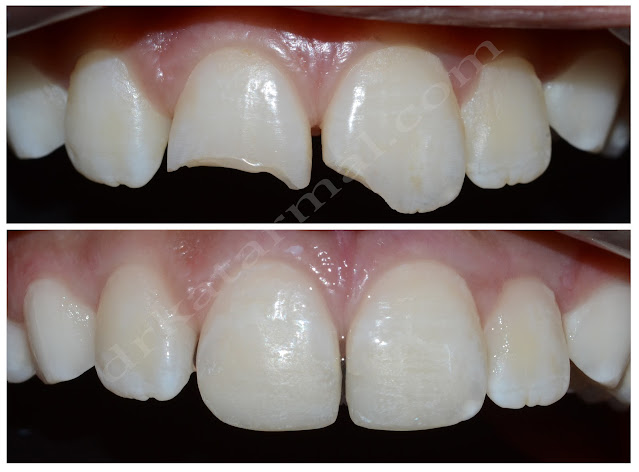 |
Tooth Fracture – A Conservative Cosmetic Solution |
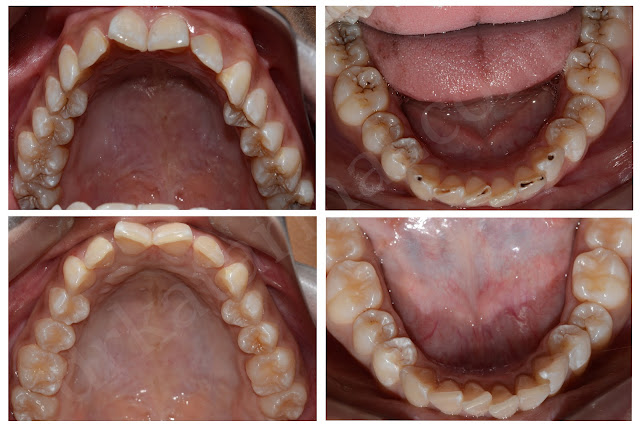 |
From Apprehension to Assurance: Panjari’s Smile Care Before
Braces |
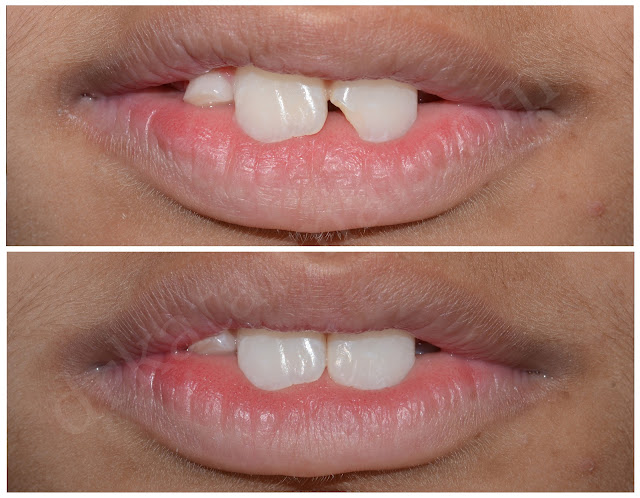 |
An 8-Year-Old’s Broken Tooth and a Restored Smile |
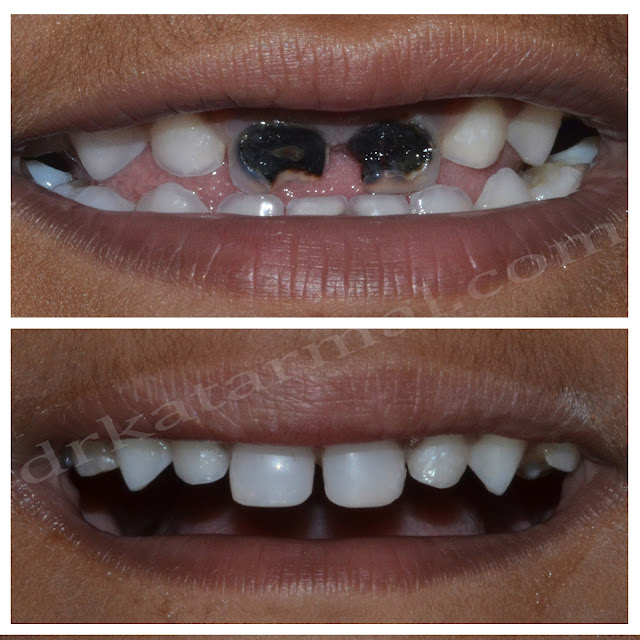 |
Meet little Anshi Gudka! |
 |
Midline Space (Diastema) Closure with Composite – A Colleague’s Smile Enhanced |
 |
Treatment of Front Tooth Cavity with Composite Filling – Laxmiben’s Smile Restored |
 |
Relief from Everyday Discomfort: Solving Food Lodgement for a 50-Year-Old Patient |
Looking for Composite Filling Treatment in Jamnagar?
If you have a cavity, black/brown spot, chipped tooth, food getting stuck between teeth, tooth sensitivity or an old defective filling, don't wait until the tooth starts hurting.
Early diagnosis may allow a simpler and more conservative restoration.
Visit Dr. Bharat Katarmal Dental & Implant Clinic, Jamnagar, for a professional examination and personalized treatment recommendation.
Your tooth deserves more than just a filling.
Our goal is to restore the tooth's health, function and natural appearance—while preserving as much healthy tooth structure as reasonably possible.


